The heir to Battle City? Top-down tanks on the living room floor
Battle City defined the top-down tank game in the 1980s. Tank Avenger brings the formula to mixed reality and adds new elements.


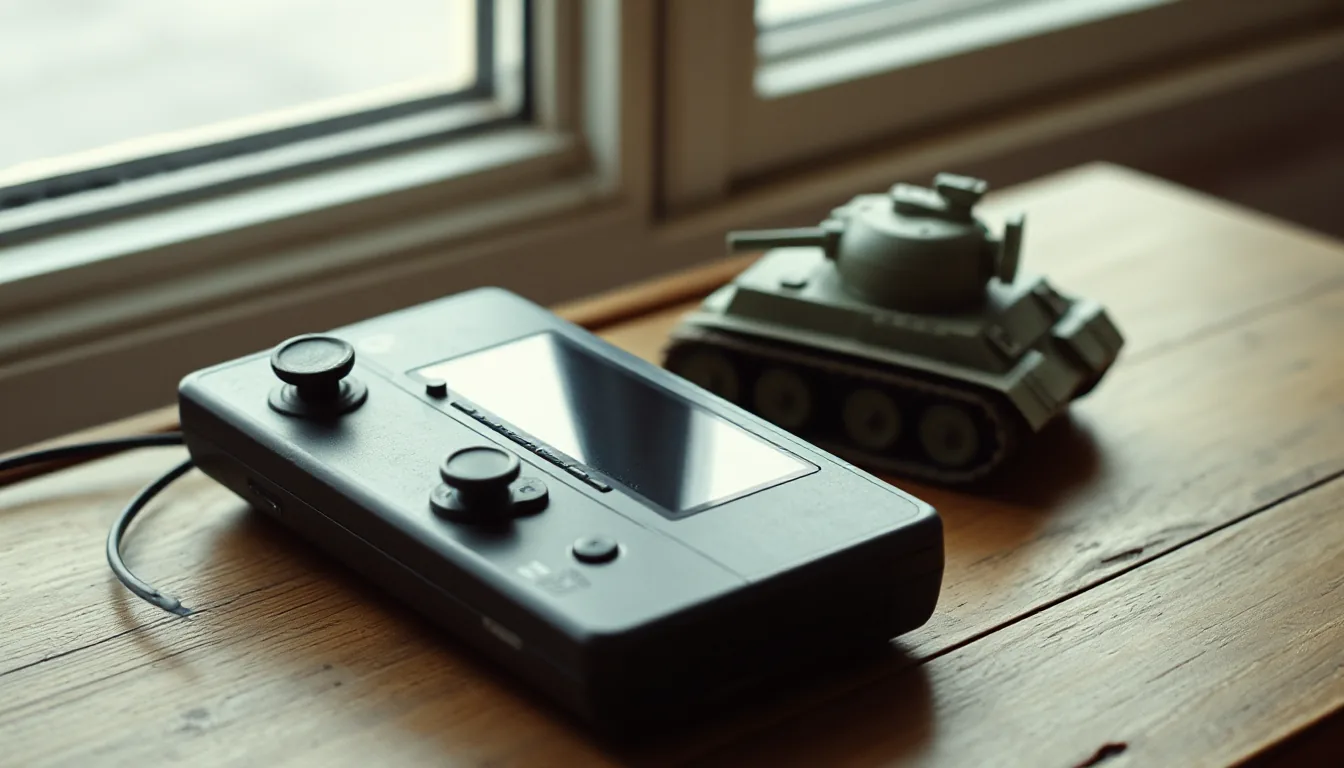
One tank, a maze of walls, enemies from every direction: with that formula, Namco’s Battle City became the definition of the tank game for a generation starting in 1985. More than 40 years later, the concept is reappearing in mixed reality. Tank Avenger – Mixed Reality for Meta Quest lays the top-down battlefield on your actual living room floor. One user in the Meta Store describes it as Battle City “completely reworked” for VR. The comparison holds, but only in part.
The original
Battle City was released in 1985 for Nintendo’s Famicom, known in the West as the NES. The game built on Namco’s 1980 arcade title Tank Battalion. The player steers a tank through a grid of brick and steel walls and defends an eagle that serves as the base. Brick walls can be shot away; steel holds firm. Two players can team up.
Also notable was the built-in construction mode. Players could assemble their own maps from walls, water, and forests. A level editor on a home console cartridge was not a given in the mid-1980s.
Battle City’s fundamentals are still easy to recognize today: a fixed top-down camera, a grid as the playing field, destructible and indestructible obstacles, and growing waves of enemies.
What Tank Avenger carries over
Tank Avenger visibly follows that grammar. The battlefield is built from cells, with walls and crates sitting as blocks in the grid. Concrete walls are generally indestructible; wooden crates, sandbags, woodpiles, or snow blocks withstand two hits. Enemy tanks chase the player through corridors and fortress courtyards.
The editor also has a successor. In the Map Workshop, the player paints maps with 14 by 14 blocks on a holographic drafting table: walls, crates, teleporters, the player’s starting position, and eight enemy types. The maps are always deathmatch and are saved locally.
What mixed reality adds
The biggest difference is the perspective. In Battle City, the player looked at a television. In Tank Avenger, the player stands over the battlefield and walks around it. Your own tank is about nine centimeters long, and the fortress appears on the largest free rectangle of the marked floor. Furniture is left out; building happens only on the floor.
That creates elements a TV-screen version doesn’t have:
- Walking around instead of scrolling: To see behind a wall, the player takes a step to the side. Driving is relative to the head’s viewing direction.
- Ricochets: Unlike in Battle City, shells bounce off walls. The Cannon bounces once, the Ricochet gun twice. According to the studio, enemy tanks plan their own bank shots.
- Cutting drone cables: Attack drones launch from a station on the real floor and hang from a cable. Shells don’t work. The player swings the controller through the cable.
- Throwing away an atomic bomb: In some levels, the battle freezes and a hand-sized warhead descends toward the tank. The player grabs it and throws it out of the play area. The fall time decreases with each encounter, from 23 down to as little as 5 seconds.
- Airspace in the room: Attack helicopters circle below head height and fire guided missiles.
Drones and the atomic bomb appear only in mixed reality mode. In the optional VR mode, where the battlefield sits on a fixed 3.5-by-3.5-meter square, both are disabled.
A larger structure
Battle City consisted of a fixed sequence of stages with one goal: hold the base and destroy all enemies. Tank Avenger expands the structure significantly. Its 202 levels are spread across four worlds: Town, Desert, Jungle, and Ice. The mode changes per level among Deathmatch, Capture the Flag, boss fights against the Juggernaut, and waves of parachute tanks.
Added to that are systems more familiar from modern mobile and arcade games: up to three stars per level, ranks from S to F, coins, and a garage with upgrades for seven weapons and the vehicle.
What’s missing
One point Tank Avenger does not share with its model: the two-player mode. According to the store, it is a single-player title without co-op. The base that must be defended is also absent. The player attacks fortresses instead of holding one.
The question of the “heir” can therefore only be answered with qualifications. Tank Avenger takes over the grid, the perspective, and the editor concept. But the feel of the game changes significantly through movement in the room, ricochets, and physical actions.
Safety in the room
Anyone walking around a floor battlefield needs clear space. Tank Avenger requires at least 1.5 square meters of lit floor; the studio recommends about 2 by 2 meters. At every start, a briefing reminds players to clear cables and toys from the floor, keep pets out of the room, and stay away from furniture.
The bottom line
Battle City shaped the top-down tank game, and Tank Avenger clearly stands in that lineage. What’s new is that the grid lies on your own floor and the player has to move: around walls, with an arm through a drone cable, with a throwing motion against the warhead. Anyone who loved the original in two-player mode will miss the absent co-op. Anyone who wants to experience the concept anew solo can find the details on the Tank Avenger store page.