Why a top-down view prevents nausea: vection explained simply
Vection is the illusion of moving while standing still. Why it can trigger discomfort in VR and why diorama games largely avoid it.


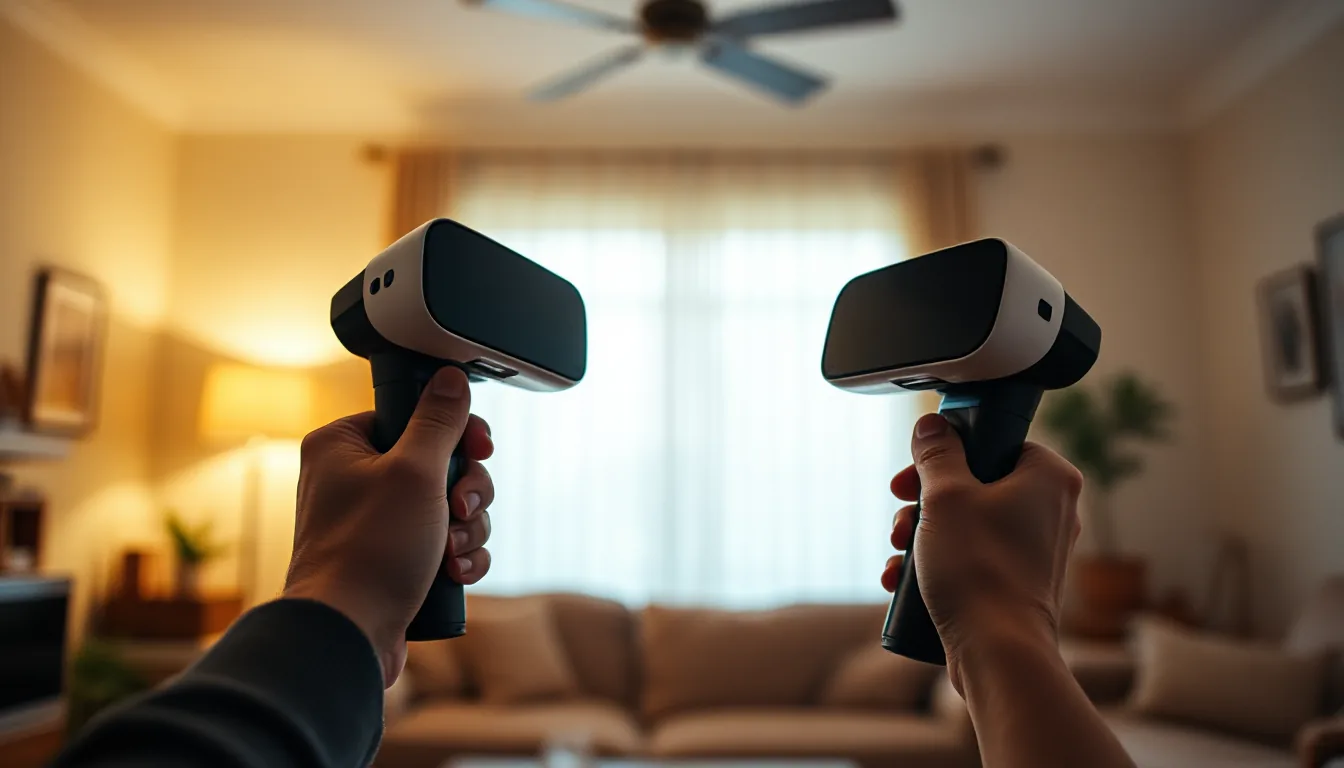
When a person sits in a train station and the neighboring train starts moving, they often feel for a moment as if they are rolling themselves. This phenomenon is called vection: a sensation of movement that arises from sight alone. In virtual reality, vection is one of the main causes of discomfort. Games with a top-down view of a miniature battlefield, such as Tank Avenger – Mixed Reality, largely avoid it because the world does not move around the player; the player moves instead.
What vection is
The brain determines self-motion from several sources. The eyes report how the image shifts. The vestibular system in the inner ear registers accelerations and rotations. Muscles and joints provide information about posture.
Normally, these signals match up. But when a large part of the visual field moves uniformly, the brain interprets that as self-motion. That is vection. It is strongest when the movement reaches the edge of the visual field—that is, peripheral vision.
Why it causes problems in VR
A common explanation for discomfort in VR is the so-called theory of sensory conflict. When a game moves the camera forward with a stick, the eyes report movement, but the inner ear reports stillness. This contradiction can cause dizziness, sweating, or nausea in some people. How severe it is varies greatly from person to person.
Typical triggers in VR games include:
- artificial forward movement with a stick
- smooth camera rotation instead of snap turns
- accelerating and braking, such as in vehicles
- camera movements the player does not initiate
Developers therefore use countermeasures: teleportation instead of sliding, rotation in fixed steps, or dimming the edge of the visual field during movement.
The diorama approach
Diorama games solve the problem more fundamentally. Instead of moving the player through a world, they place a small world in front of them. The view remains firmly anchored in the room. If something moves, it is figures or vehicles in the diorama, which occupy only a small part of the visual field.
If the player wants a different perspective, they turn their head or take a step. The eyes and inner ear then report the same thing. There is no sensory conflict because the movement is real.
The Tank Avenger example
Tank Avenger is a top-down tank game that builds a miniature battlefield on the open floor of the room. The player’s tank is about nine centimeters long. The player controls it with the left stick, but the camera does not follow the tank. It stays where the player’s head is. To see behind a fortress wall, the player walks around the battlefield.
Meta rates the game in the Store as “Comfortable for most,” the most favorable level on Meta’s comfort scale, which also includes “Comfortable for some” and “Comfortable for few.” The controls are also tuned to the diorama view: the tank drives relative to the head’s viewing direction. Pushing the stick forward sends the tank away from the player’s position.
In the optional VR mode, little changes. The battlefield then lies on a fixed 3.5-by-3.5-meter square in a themed world, and the player still moves themselves.
Limits of the approach
A top-down view lowers the risk, but it does not eliminate it for everyone. Some points remain:
- The player’s own head movements: Frequent bending forward and walking around can tire some people.
- Moving objects in the room: In Tank Avenger, attack helicopters circle below head height, and attack drones rise to about 1.7 meters. These objects are small, but they are close to the face.
- Special perspectives: During the helicopter power-up, the player controls a transport helicopter above the battlefield. The camera stays with the player, but the gaze is directed at a flying object.
- Screen time: Long sessions without a break can be tiring regardless of genre.
Tank Avenger’s safety briefing therefore advises taking a break if a player feels dizzy and never walking backward blindly.
What players can do themselves
Generally proven rules for comfortable play are simple. Short sessions help when starting out. A well-fitting headset with correctly adjusted eye spacing reduces blur. Anyone who feels discomfort should end the session immediately and not “push through.” A well-lit room helps in mixed reality because the headset can then better capture the surroundings.
The bottom line
Vection occurs when the image moves but the body does not. Diorama games reverse the principle: the world stays still, and the player moves. Tank Avenger uses this approach consistently and is therefore rated “Comfortable for most” by Meta. It is not a guarantee for every player, but it is a solid starting point for anyone who quickly feels discomfort in other VR games.